
The S.P.R.T.
The Society for the Propagation of Religious Truth

Regarding the founding and naming of the Society for the Propagation of Religious Truth
Regarding the founding of the ‘Society for the Propagation of Religious Truth’, and the reasons for founding it, Aleister Crowley only wrote in Confessions:
“My activities as a publisher were at this time remarkable. I had issued The God-Eater and The Star & the Garter through Charles Watts & Co. of the Rationalist Press Association, but there was still no such demand for my books as to indicate that I had touched the great heart of the British public. I decided that it would save trouble to publish them myself. I decided to call myself the Society for the Propagation of Religious Truth, and issued The Argonauts, The Sword of Song, The Book of the Goetia of Solomon the King, Why Jesus Wept, Oracles, Orpheus, Gargoyles and The Collected Works. I had simply no idea of business. Besides this, I was in no need of money; my responsibility to the gods was to write as I was inspired; my responsibility to mankind was to publish what I wrote. But it ended there. As long as what I wrote was technically accessible to the public through the British Museum, and such places, my hand were clean.” (Confessions, Chapter 50.)
But there was clearly much more to it, things, which I have focused on in For the Thelemites!
Aleister Crowley was at war! At that time with himself; with the Gods; with Christianity; with Buddhism; with the old Aeon; with the Golden Dawn; with the new Aeon of Horus, and its book Liber L vel Legis (a book almost not studied!); with G. K. Chesterton; with publishers, journalists and editors.
Authors writing about Crowley and the S.P.R.T. have fastened on his words in Confessions, and briefly mentioned the ‘parody’ aspect (the Church of England’s Society for Promoting Christian Knowledge) and a few other things.
However, no one has noticed the statement by Crowley given below, a statement saved by the British-born psychic researcher, Ph.D., and author Hereward Carrington (born Hubert Lavington) (1880-1958), who published it a year before Crowley’s death, thus while he was still alive, and he could well have read it:
“I have spoken of Crowley's poetry. Typical of this unforgettable man's attitude is the following incident. He published a volume of verse of such spiritual quality that many of his poems were set to music and sung in a certain church. Then someone pointed out that all these poems represented merely veiled sex-symbolism. Horrified, they were rejected and his books publicly burned. Crowley was delighted at this, and the title-page of his next book bore the legend, "Published by the Society for Promoting [sic] Religious knowledge [sic].”” (Published in the Occult Quarterly The Kalpaka; Issue of Oct., Nov., Dec., 1946 E.V.)
The first book issued under the imprint of the S.P.R.T. was The Argonauts (July, 1904 E.V.), and the book that appeared before it was The Star and the Garter published by Watts & Co. in London in 1903 – The Star and the Garter, which Crowley in Confessions called “the greatest love-poem of modern times”! As I have stated in For the Thelemites (see the extract “Amphora”), had this to do with the English Vicar Cecil Henry Verey (1872-1958), who studied at Cambridge at the same time as Crowley, and who perhaps was the “Rev. C. Verey” of Clouds without Water, a book whose title page stated: “EDITED FROM A PRIVATE MS. BY REV. C. VEREY”, and further: “PRIVATELY PRINTED FOR CIRCULATION AMONG MINISTERS OF RELIGION”?
Or, was it the English author Gilbert Keith Chesterton (1874-1936), who most strangely after having partly reviewed The Sword of Song from the S.P.R.T. in The Daily News, promising to complete the review the week after, then suddenly refused to do so, even after that Crowley had written to him stating: “I am anxious to meet you in fair fight...” (see the extract “Ye Sword of Song”)? Chesterton stopped reviewing Crowley’s books after this incident, and it is obvious to ask whether he had anything to do with the mentioned church! It seems that Crowley had sent a copy of The Sword of Song to Chesterton’s private address, instead of sending it to The Daily News, as was the normal procedure, and done before it had been sent to other newspapers and journals, in hope of enticing Chesterton to start the debate about Christianity and ‘religious truth’ that Crowley wanted, the reason for his founding of the S.P.R.T.! It would explain why Chesterton suddenly refused to debate, fearing that Crowley would refer to the incident preserved in the words of Hereward Carrington!
For Hereward Carrington and his meeting with A.C. in America, see the extract “Occult Study” on the page “Carthage 1923 E.V.”; the extract “Confessions, 1929 E.V.”; and the last part of the extract “John Bull”!
As I have stated in For the Thelemites (see the extract “The Method of Science – The Aim of Religion”, on the page “Fill and Kill”):
“Crowley was a born sceptic who happened to be brought up with the Old Testament in one hand and the New Testament in the other. He was well versed in the fusion called the Christian Bible. […] Crowley’s natural scepticism and critical faculty were fed by the religion that he was brought up with and it is this grown scepticism which burst into flames during the Cairo Working and lasted, as we have seen, almost for the next five years. […] Fra. P. was tired of the theory and practice used in occultism as well as in religion – he needed proof to find success and they needed to be tested!”
For the Thelemites contains the first publication and discussion of the letters published in the English weekly journal Truth sent from the S.P.R.T. – at that time Crowley in disguise – and the answers to them from the journal’s owner and editor, the English liberal politician and writer Henry (Du Pré) Labouchère (1831-1912). (See the extract “A.C. – Books and Dates” found on the page “February 1913 E.V.”)
Finally, regarding that Aleister Crowley was at war, late in his life, while living in Hastings, the following statement by him was preserved by James Laver (1899-1975), curator at the Victoria and Albert Museum:
“Crowley was also at war with the O.T.O. or Ordo Templi Orientis, and apropos of this conflict Crowley told me the following strange story.” (See the extract “February 1913 E.V.”)
Ordo Templi Orientis is the first of the great Old Æon orders to accept The Book of the Law!
⁂
As to the naming ‘Society for the Propagation of Religious Truth’, the British statesman William Ewart Gladstone (1809-1898), whom Aleister Crowley had disliked as a seventeen years old schoolboy, had in 1838 written the book The State in its Relations with the Church, a book that through a famous fifty-page review of it by the Whig politician Thomas Babington Macaulay, 1st Baron Macaulay, PC (1800-1859) in The Edinburgh Review had been immortalized. Macaulay, who some months after the review was made Secretary of War, stated about the work:
Mr Gladstone's whole theory rests on this great fundamental proposition, – that the Propagation of Religious Truth is one of the principal Ends of Government, as government.
– W. E. Gladstone assuming, of course, that religious truth was embodied purely in the doctrines and teachings of the English Church. W. E. Gladstone's political enemies often recalled the book's doctrines to mind, and Crowley of course knew the above and probably also took some inspiration from it when he went to war and named his publishing house ‘Society for the Propagation of Religious Truth’! [Mentioned in Chapter 11 of For the Thelemites – See the extract “The Method of Science – The Aim of Religion”, found on the page “Fill and Kill”]
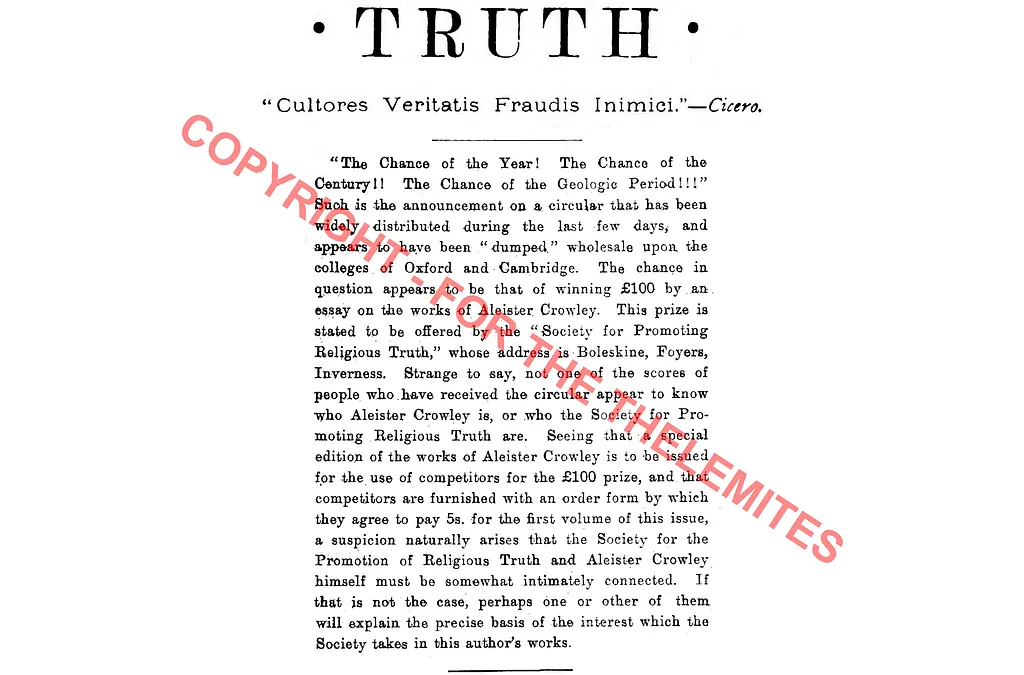
• The S.P.R.T.’s Essay Competition mentioned in the English weekly journal Truth, February 2, 1905 E.V. (Truth; "Cultores Veritatis Fraudis Inimici." – Cicero. London, UK: “Truth” Buildings. ● Vol. LVII, No. 1466, Thursday, February 2, 1905, p. 270.)
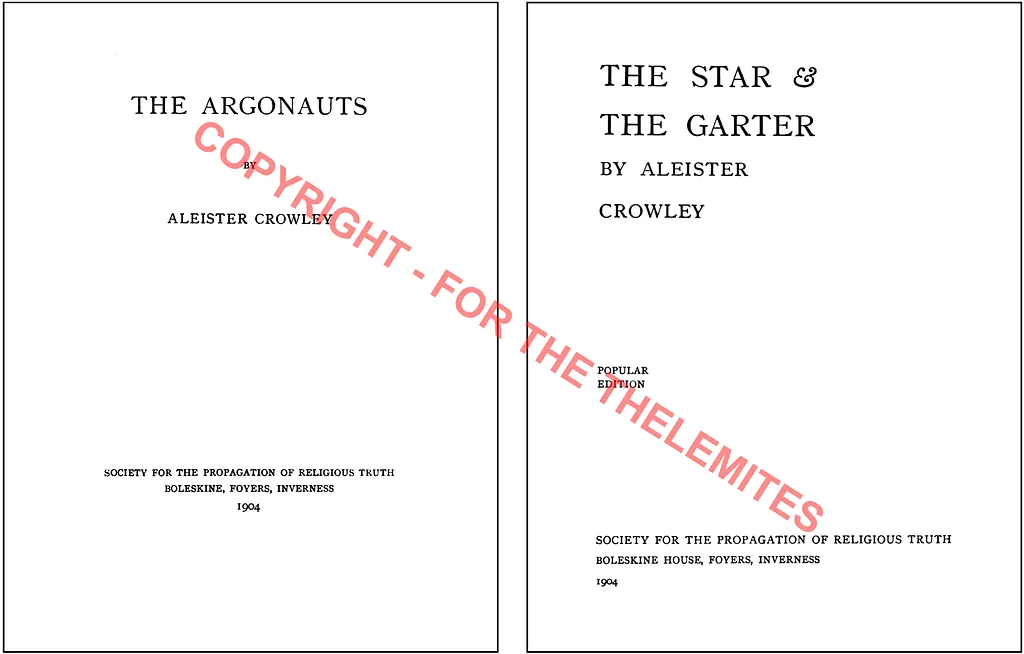
• (Left) Title page of The Argonauts, the first book published by the S.P.R.T., July 1904 E.V., thus shortly after the Cairo Working and the Crowleys return to Scotland. (Right) Title page of the new ‘Popular Edition’ of The Star & the Garter, published by the S.P.R.T. in September and October 1904 E.V.. The 77-page book was priced at 1s. The book had originally been published in 1903 by Charles Watts & Co. in London.
The Word of the Law is θελημα – Do what thou wilt shall be the whole of the Law
Φ
Copyright @ Perdurabo ST - All Rights Reserved 2026 E.V.